Martin Novák
“FOR ME, THE EXPERIENCE OF HUNTING IS MORE IMPORTANT THAN THE TROPHY ON THE WALL.”
Most people know him as a chef and from television. But Martin Novák also has a close connection to hunting, nature and travel. This summer alone, he has travelled to Namibia, Argentina and Alaska. We spoke to him about his beginnings as a hunter, cooking with game meat, hunting in Argentina’s La Pampa and why, for him, the trophy itself is not what matters most.
MOST PEOPLE KNOW YOU AS A CHEF AND FROM TELEVISION. HOW DID HUNTING BECOME PART OF YOUR LIFE?
I was introduced to hunting at a very young age, as my grandfather was a hunter. I will never forget the moments we shared. Whenever he went out into the countryside, we would spend time together in nature, observing wildlife and looking for tracks to see which animals had passed through.
I can still vividly remember my grandfather’s hunting hat, coat and belt, as well as his old side-by-side break-action shotgun. Although the gun was no longer in working order, those memories have stayed with me.
My love of nature remained with me over the years. I enjoy the mountains and forests, not only as a hunter but also as a hiker. I also enjoy bushcraft and like spending several days in the wilderness, sleeping in the forest.
As I got older, I occasionally started joining friends on hunts. We were already sport shooters, and one day we thought it might be a good idea to obtain hunting licences as well. We enrolled in a hunting course, and hunting has now been part of our lives for several years.
As young hunters, one of the first things we had to work out was where we would actually hunt. We went on several commercial hunts before eventually finding a place where we now hunt regularly.
Today, hunting is above all an escape from the pressures of everyday life for me. In the forest, I relax, clear my mind and recharge. It is also a time for observing nature and meeting friends. And, of course, there is the added benefit of high-quality game meat, which I bring home and prepare for my family.
I am delighted that my older son is now beginning to join me as well. He is gradually discovering nature and hunting, so I hope this tradition will continue to be passed down naturally in our family.
YOU WORKED WITH GAME MEAT AS A CHEF LONG BEFORE YOU BECAME A HUNTER. DID HUNTING CHANGE THE WAY YOU VIEW THE MEAT THAT ENDS UP IN YOUR KITCHEN?
Hunting did not fundamentally change the way I approach game meat. I had already worked with it extensively throughout my career as a chef. I started out in hotels in Bratislava, where game dishes were a regular feature on restaurant menus. I therefore worked with roe deer, red deer and wild boar almost every day. Even then, I was learning not only how to prepare game meat, but also how to age it, portion it and process it further.
Game meat was therefore familiar to me long before I became a hunter. Hunting, however, broadened my perspective and gave me a better understanding of the origin of the meat I work with in the kitchen.
Later in my career in gastronomy, I always tried to include at least one game dish on the seasonal menu – whether wild boar, red deer or roe deer. I have always preferred local and seasonal ingredients, using whatever is available in a particular region at a given time.
Many people are still somewhat wary of game meat. They think it has an unpleasant smell or an overly strong flavour. But this is largely a matter of proper handling and preparation. That is why I try to dispel these misconceptions and show that game meat can be prepared in a modern, light and appealing way – one that can win over even those who would not normally choose it.
In my opinion, game meat is among the healthiest types of meat. Wild animals live freely in nature, move naturally and choose their own food. Of course, today’s environment is not entirely untouched, but I still consider game meat a more natural alternative to meat from intensive farming.
I believe people should give it more of a chance. We have plenty of it, it is a locally sourced, high-quality protein, and when prepared properly, it can be part of modern, varied cuisine. In the future, I would therefore like to devote more attention to raising awareness and bringing game meat to a wider audience. Whenever I have a choice in the kitchen, I always give it preference over conventional meat.
THIS SUMMER, YOU TRAVELLED THROUGH NAMIBIA, ARGENTINA AND ALASKA. WHAT DRAWS YOU TO THESE JOURNEYS – THE HUNT ITSELF OR RATHER THE OPPORTUNITY TO DISCOVER THE COUNTRY?
What I enjoy most about travelling is discovering new parts of the world and having the opportunity to see with my own eyes what I had previously only seen in television documentaries.
In Namibia, we saw elephants, giraffes, zebras, wildebeest and lions living freely in the wild. We travelled around 2,300 kilometres across the country, visited Etosha National Park, the Atlantic coast and the sand dunes. We had a very varied itinerary, which gave us the opportunity to discover the country’s wildlife, meet local people and learn about their culture and way of life.
Hunting was also part of the trip. I harvested a female oryx because I consider its meat to be of very high quality. We prepared steaks and ragù from it, and I also had the opportunity to taste various game dishes, as well as dishes prepared by local people and our guides. Cooking and dining together were among the experiences from Africa that have stayed with me most vividly.
In Argentina, after visiting Buenos Aires, we continued on to La Pampa. There, we encountered an abundance of free-ranging wildlife. We harvested a red deer and a wild boar and, naturally, prepared meals from the meat afterwards. As it was Sunday, we made schnitzels from the wild boar and served them with potato salad. We cooked the venison in red wine and served it with polenta, cheese and roasted vegetables. The locals have their own culinary traditions and use different ingredients, but I enjoyed their cuisine.
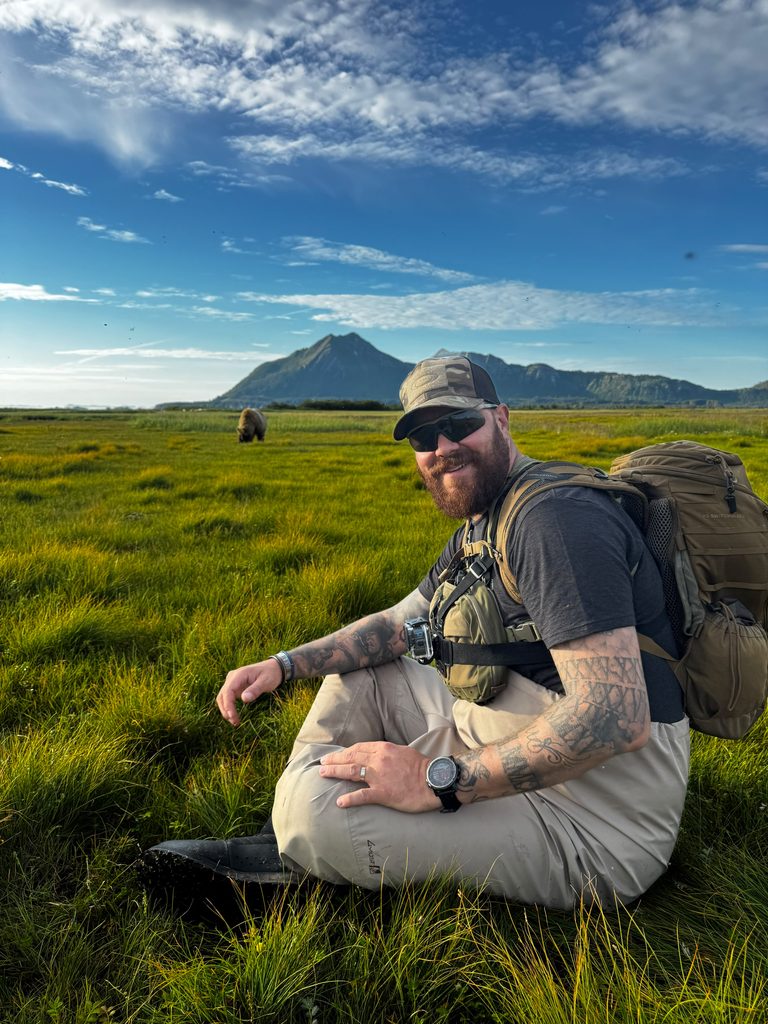
Alaska was a completely different experience. Hunting is not permitted in Katmai National Park, but we did go fishing. As we were staying on a boat, I also cooked for the crew. The most memorable experience, however, was the wilderness itself – pristine rivers, lush forests, snow-covered peaks and an incredible number of brown bears. We were also fortunate enough to see a lynx. The only animals we had hoped to encounter but did not see were wolves.
I brought home many unforgettable experiences from every journey, but I would definitely like to return to Alaska if I have the opportunity. It is perhaps the place where you truly understand how untouched nature works when it is allowed to remain genuinely wild.
LET’S STAY WITH ARGENTINA. WHAT WAS THE HUNT ITSELF LIKE AT TERRA PAMPA?
The hunt was relaxed, with no unnecessary rush. Early in the morning, our guide picked us up. My guide was Sixto, a local gaucho who spoke only Spanish and knew just a few words of English. Despite the language barrier, we always managed to communicate somehow – sometimes with words, sometimes with gestures.
Terra Pampa covers approximately 35,000 hectares, which is only slightly smaller than half the size of Bratislava. In an area this vast, much of the hunting involves moving through the hunting grounds by vehicle and then continuing on foot in search of game.
Our main target was a good red stag. However, the rut was already over and the animals were extremely wary. Twice, I managed to get close to one, but each time the stag disappeared before I could take a shot. We followed its tracks, but I did not feel that they were actually leading us directly to the animal.
Later, we continued in a way that could perhaps be compared to a vehicle-based search. We drove through the hunting grounds, stopped at suitable locations, got out and scanned the surrounding area with binoculars. During one of these moves, four large stags crossed our path. One of them caught my attention, and I managed to harvest it from a distance of approximately 100 to 120 metres. The shot was accurate, and the stag dropped on the spot.
Later, I also harvested a wild boar weighing approximately 70 to 80 kilograms. We took the harvested game back to the ranch, where it was processed. Together with the locals, we even had an informal competition to see who could butcher and process the game more quickly and efficiently. Many of the locals do this in a very similar way to what I am used to back home, so our Slovak group certainly held its own.
The entire hunt was enjoyable and interesting, although for me personally it was not as physically demanding as hunting in Africa. I enjoy stalking on foot, moving through the terrain and having a more direct connection with nature. Argentina, however, offered a completely different style of hunting and an experience I had never had before.
TERRA PAMPA, HOWEVER, WAS NOT ONLY ABOUT HUNTING. WHAT IMPRESSION DID LIFE ON AN ARGENTINE RANCH LEAVE ON YOU?
Terra Pampa itself was a beautiful ranch that has been in the same family for four generations. The family is involved in cattle and horse breeding. If I remember correctly, in the 1950s they were among the largest beef producers in Argentina. Today, the ranch has around seven thousand head of cattle and a large number of horses.
We also had the opportunity to go horse riding accompanied by local gauchos. We rode through a beautiful stretch of the Argentine countryside, and it was one of the highlights of the entire stay. The only slight concern was that one of the ladies in our group was afraid of horses. But even she eventually got into the saddle, which earned her great respect from those of us who ride regularly.
Food was also a major part of our stay. The ranch had excellent cooks who prepared a variety of dishes for us, and I have to say that I thoroughly enjoyed every one of them. Naturally, the menu was predominantly meat-based. With seven thousand head of cattle on the ranch, I would hardly have expected anything else.
We happened to be in Argentina during the FIFA World Cup, so the atmosphere was extraordinary. Everyone lived and breathed football – from the staff and cooks to the ranch owners themselves. Football is almost a religion to them. And if you ask whether Maradona or Messi was better, you have to expect the discussion to go on for several hours.
Of all the food, the empanadas have stayed with me the most. Argentinians prepare them both baked and fried. We had baked empanadas in several places in Buenos Aires, but at the ranch they prepared them fried. When they brought out thirty and we ate them all, they immediately made another thirty. In the end, we decided not to ask for any more because we had the feeling they would simply keep bringing them.
Having worked in an Argentinian steakhouse in the past, I was already somewhat familiar with the country’s cuisine. The empanadas at the ranch, however, were among the best I have ever eaten. The meat was equally excellent, as were the steaks. Add good Argentinian wine and one of the country’s culinary icons – dulce de leche – and the experience was complete.
Dulce de leche is a thick, sweet milk caramel, somewhat reminiscent of condensed milk but with a much more pronounced caramel flavour. Argentinians use it in desserts, on pancakes and simply enjoy it as a sweet treat on its own. We liked it so much that we even brought some home with us.
Those are probably my strongest memories of life on the ranch and everyday life at Terra Pampa. I think everyone there made the most of their stay.
WHEN YOU COMPARE AFRICA, ARGENTINA AND ALASKA, WHICH JOURNEY HAS STAYED WITH YOU THE MOST? AND IS THERE STILL A HUNT YOU WOULD LIKE TO EXPERIENCE ONE DAY?
It is difficult to choose just one, because each journey had a different atmosphere and left me with something unique.
Alaska was exceptional above all because of the intense connection with nature. We slept on a boat and went ashore several times a day in small boats. We came within close range of bears, and in the streams we even tried catching salmon with our bare hands. We went hiking, fishing, explored the forests and experienced truly untouched wilderness.
Argentina had a completely different energy. Beautiful regions, open and friendly people and fascinating nature. Life on the ranch, the opportunity to experience the cattle and horses up close, as well as the challenging conditions – all of it had its own distinctive atmosphere.
Africa, for me, is simply extraordinary. It has beautiful nature and wonderful people. I have also made some good friends there. What struck me most was how the local people can appreciate even the smallest things and how genuinely happy they are. Compared with our fast-paced, modern way of life, Africa feels in many respects like a completely different world.
Africa and Alaska in particular – especially the encounters with bears – are among the experiences I will remember for the rest of my life.
When I think about a dream hunt, I do not have a particular species that I would want to bring home as a trophy at any cost. I do not see hunting as a list of species that I need to harvest one by one and hang on the wall.
What attracts me most is a hunt where you genuinely connect with nature. I can imagine staying in a beautiful mountain cabin, spending long days on foot and travelling through a landscape far from civilisation. I do not need everything to go perfectly from the very first day. I like a hunt to be a challenge – when you gradually begin to understand how the game moves, whether you can find it at all, track it down and eventually get the right opportunity.
That is when the sense of achievement is much greater. I cannot say whether it should be an ibex, a chamois or another species. Every animal is beautiful in its own way. What matters far more to me is the memory I bring home and the experience of the entire journey. That is why, for me, the experience of hunting is more important than the trophy on the wall.