Genetic and Health Survey of the Western Capercaillie (Tetrao urogallus) in the Tatra Mountains
In 2022 and 2023, the Tatra National Park Administration participated in sample collection as part of the project “Implementation of Selected Measures of the Western Capercaillie Conservation Programme”, ITMS 310011BKH4, under the auspices of the State Nature Conservancy of the Slovak Republic. In this way, the Tatra National Park Administration also contributed to the preparation of the document “Conservation Programme for the Western Capercaillie (Tetrao urogallus Linnaeus, 1758) for 2025–2029”.
Thanks to the teamwork of researchers, conservation district staff and rangers from Orava to the Tatranská Javorina area, as well as members of the public involved in the project, a total of 135 capercaillie faecal samples were collected. These were used primarily for genetic analyses at the molecular laboratory of the Faculty of Forestry at the Technical University in Zvolen. The Tatra National Park Administration expanded the research to include an assessment of the health status of the capercaillie based on parasitological analyses conducted in cooperation with the Institute of Parasitology in Košice.
The genetic survey revealed that capercaillies in the Tatra Mountains and Spišská Magura form a distinct Tatra genetic group, separate from neighbouring capercaillie populations in the Oravské Beskydy Mountains and the Low Tatras. These populations are also genetically distinct from one another and form two separate groups (Figure 1).
Based on allele frequencies, the Tatra group differs from the neighbouring populations as a result of limited gene flow between them. Evidence of allele introgression between Orava and the Tatras may be the result of historical gene flow and shared ancestry.
When assessing genetic variability, an important indicator is effective population size, which is derived from the concept of an ideal population. In 2022, effective population size became the basis of a key indicator for monitoring and reporting genetic diversity within the monitoring framework of the United Nations Convention on Biological Diversity (CBD) and the Kunming–Montreal Global Biodiversity Framework (GBF).
Current guidelines recommend a minimum effective population size of 50 to prevent short-term inbreeding and 500 to maintain a population’s ability to adapt to changing environmental conditions. The effective population size of the Tatra population is 61.5, with the upper interval not exceeding 170.
A small, isolated population is more susceptible to the negative effects of genetic drift over a relatively short period. This may randomly lead to the fixation of harmful alleles and the permanent loss of others. As a result, populations diverge, genetic variability declines and their ability to adapt to changing environmental conditions is reduced. A higher risk of inbreeding and reduced viability can cause irreversible negative changes in most populations of wild species. Information on the genetic factors influencing population dynamics is therefore crucial to the study and conservation of endangered species. It follows from these findings that the Tatra capercaillie population is losing its adaptive capacity as a result of isolation from neighbouring populations and the consequent increase in relatedness among individuals, which leads to a decline in genetic variability.
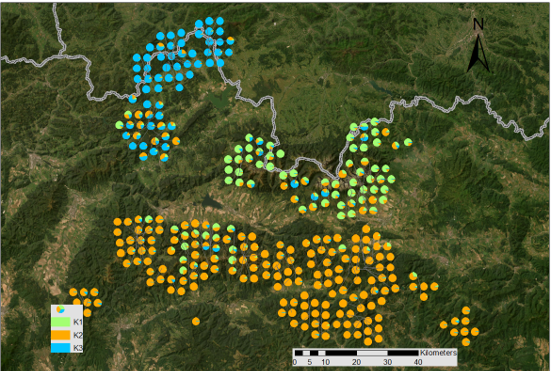
Figure 1. Assignment of individual capercaillies to three genetic groups based on allele frequencies. The pie charts show the proportion of alleles shared with other individuals across the three groups.
Parasitic infections in wild animals can cause considerable direct losses through mortality, as well as indirect effects such as slower growth, weight loss and reduced resistance to predation. The harmful effects of parasites depend on the overall resistance of the host organism, its current state of health, the availability of sufficient high-quality food and the parasite burden within the body.
Under natural conditions, more than 50% of all helminth developmental stages are destroyed by sunlight and approximately 30% by other natural factors. Nevertheless, the remaining developmental stages are still sufficient to maintain continuous environmental contamination and cause reinfection of wildlife.
From an ecological perspective, the presence of parasites in wild animals is a natural phenomenon, and low-intensity infections do not produce significant adverse effects. Another limiting factor is that, in protected areas, populations of definitive hosts and intermediate hosts cannot be eliminated, making parasite occurrence difficult to control.
Fortunately, the results did not confirm any significant impact of the capercaillie parasite fauna on the birds’ health. Of the 67 samples examined, 69% were negative. The remaining samples tested positive for the nematodes Ascaridia galli (3%) and Capillaria sp. (16.5%), the coccidian Eimeria sp. (6%) and the tapeworm Raillietina sp. (6%) (Figure 2).
If high-intensity infections with the aforementioned parasite species were detected, they could manifest themselves in various ways in individual capercaillies. For example, coccidiosis (eimeriosis), caused by parasitic protozoa of the genus Eimeria, may result in inflammation of the small intestine, diarrhoea, disorders of the nervous system and subsequently anaemia. Chicks that have not yet developed sufficient immunity may be particularly susceptible.
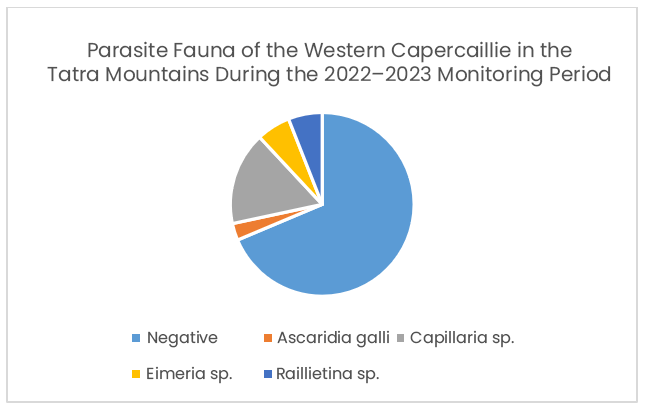
Figure 2. Composition of the parasite fauna identified in Western Capercaillies in the Tatra Mountains.
Health status, physical condition and the availability of high-quality food are indicators of the quality of the habitat in which the capercaillie lives. High-quality habitats are crucial to maintaining its population not only in the Tatra Mountains but throughout Slovakia. This can be achieved by protecting existing habitats and creating new suitable habitats that promote connectivity with the surrounding mountain ranges.
This is essential for maintaining genetic variability and, consequently, the long-term viability of the species. Creating canopy gaps helps to open up the structure of young forest stands, which is necessary to improve habitat conditions for the capercaillie.
By protecting existing habitats, applying appropriate forest management practices, creating ecological “stepping stones” – suitable habitats between mountain ranges that enable capercaillies to travel over considerable distances – reducing human disturbance and carrying out systematic monitoring, we can connect the capercaillie population in Tatra National Park with populations in Low Tatras National Park and outlying populations. Such connectivity is crucial to ensuring the long-term viability of the species.